


She Grew Up Under Apartheid. Decades Later, She Investigated Gaza
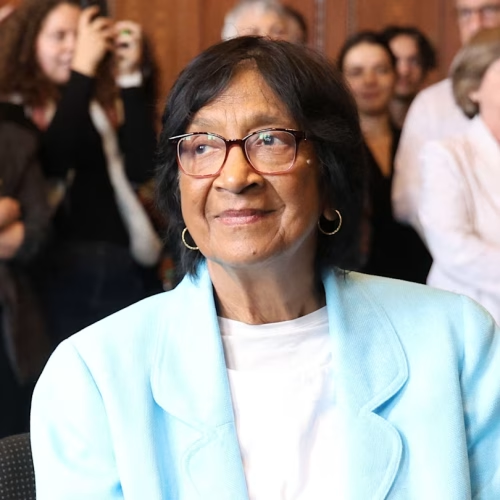
14 Oct 2026Navi Pillay’s journey from discrimination in South Africa to the 2026 Nobel Peace Prize raises a question that matters far beyond the courtroom: can the law hold the powerful accountable?
Before Navi Pillay investigated crimes in Gaza, she knew what it meant to live under a system that treated people differently because of their race.
Born in Durban in 1941 into a family of Indian Tamil heritage, she grew up under apartheid. South Africa’s laws separated communities by race and gave the white minority greater rights and opportunities. As a woman of colour entering the legal profession, she faced barriers on more than one front.[2][3]
Decades later, she would chair the independent UN commission that concluded Israel had committed genocide against Palestinians in Gaza. On 9 October 2026, she was awarded the Nobel Peace Prize for her efforts to promote peace and international law.[1][5]
For readers following Palestine, the connection is compelling. Pillay’s career brings the experience of discrimination into the institutions meant to confront abuses of power. It also raises a difficult question: what happens when evidence of grave crimes meets resistance from those accused?
Her work began close to home. In 1967, she opened her own legal practice in Natal, defending anti-apartheid activists and helping secure prisoners’ rights. She used the law to challenge abuses within a country whose legal system also enforced racial inequality.[3]
In 1995, after apartheid had ended, she became the first non-white woman to serve as a judge on South Africa’s High Court. Someone who had faced exclusion was now helping administer justice.[2][3]
Her career then took her to the international tribunal established to prosecute crimes committed during the 1994 genocide against the Tutsi in Rwanda. She was one of the judges in the landmark 1998 trial of Jean-Paul Akayesu, which recognised that rape and other sexual violence could constitute genocide when committed with the intention of destroying a protected group.[4]
The ruling helped change how international law understood the destruction of communities. Survivors’ testimony was central to establishing responsibility. Listening to people who had suffered could shape the law itself.
Pillay subsequently served at the International Criminal Court and, between 2008 and 2014, as UN High Commissioner for Human Rights, the organisation’s leading human rights official.[2]
Her later work on Gaza brought those questions of evidence and accountability into a conflict closely followed by Muslim communities.
In September 2025, the independent commission she chaired concluded that Israeli authorities and security forces had committed four of the five acts listed in the Genocide Convention. Its assessment examined both their conduct and evidence of intent to destroy Palestinians in Gaza as a group.[5]
Genocide has a precise legal meaning: certain acts committed with the intention of destroying all or part of a national, ethnic, racial or religious group. Establishing that intent is essential. The acts can include killing, causing serious physical or mental harm, and deliberately imposing conditions calculated to destroy the group.[6]
Israel rejected the commission’s findings and accused it of bias. The report was an investigative conclusion, rather than a criminal conviction or a judgment by the International Court of Justice.[7]
Pillay’s Nobel award recognises her wider career. It does not turn the Gaza report into a court verdict, and the committee did not award the prize solely for that investigation.[1]
Even so, her recognition creates an opportunity to ask what accountability should mean beyond reports, headlines and ceremonies. Families facing violence need protection. Survivors need support. Evidence needs institutions willing and able to act on it.
For young Muslim readers, Pillay’s story also opens a conversation about solidarity. Concern for Palestinian lives can be part of a wider commitment to human dignity, connecting people across faiths and backgrounds. That commitment asks us to take injustice seriously wherever it occurs.
Her journey offers hope, but it leaves a challenge too. A woman who grew up facing discrimination helped shape the rules used to judge some of the world’s gravest crimes. The question now is whether governments will give those rules the force that victims need.
A prize can honour the pursuit of justice. The people waiting for justice need more than recognition.
Sources:
- Norwegian Nobel Committee, award announcement
- Nobel Prize, Navi Pillay biography and facts
- OHCHR, Navi Pillay biography
- UN International Residual Mechanism for Criminal Tribunals, ICTR retrospective
- OHCHR, commission’s genocide findings, 16 September 2025
- UN Office on Genocide Prevention, definitions
- Reuters, explanation of the inquiry’s findings, 18 September 2025
Latest Articles

Insert article headline here
03 Jun 2026

She Grew Up Under Apartheid. Decades Later, She Investigated Gaza
Navi Pillay’s journey from discrimination in South Africa to the 2026 Nobel Peace Prize raises a question that matters far beyond the courtroom: can the law hold the powerful accountable?
South Africa Debates Muslim Marriages After Spouses of Coronavirus Victims Left Without Support
South Africa is debating the recognition of Muslim marriages after numerous families who lost members to the coronavirus were left without legal support.